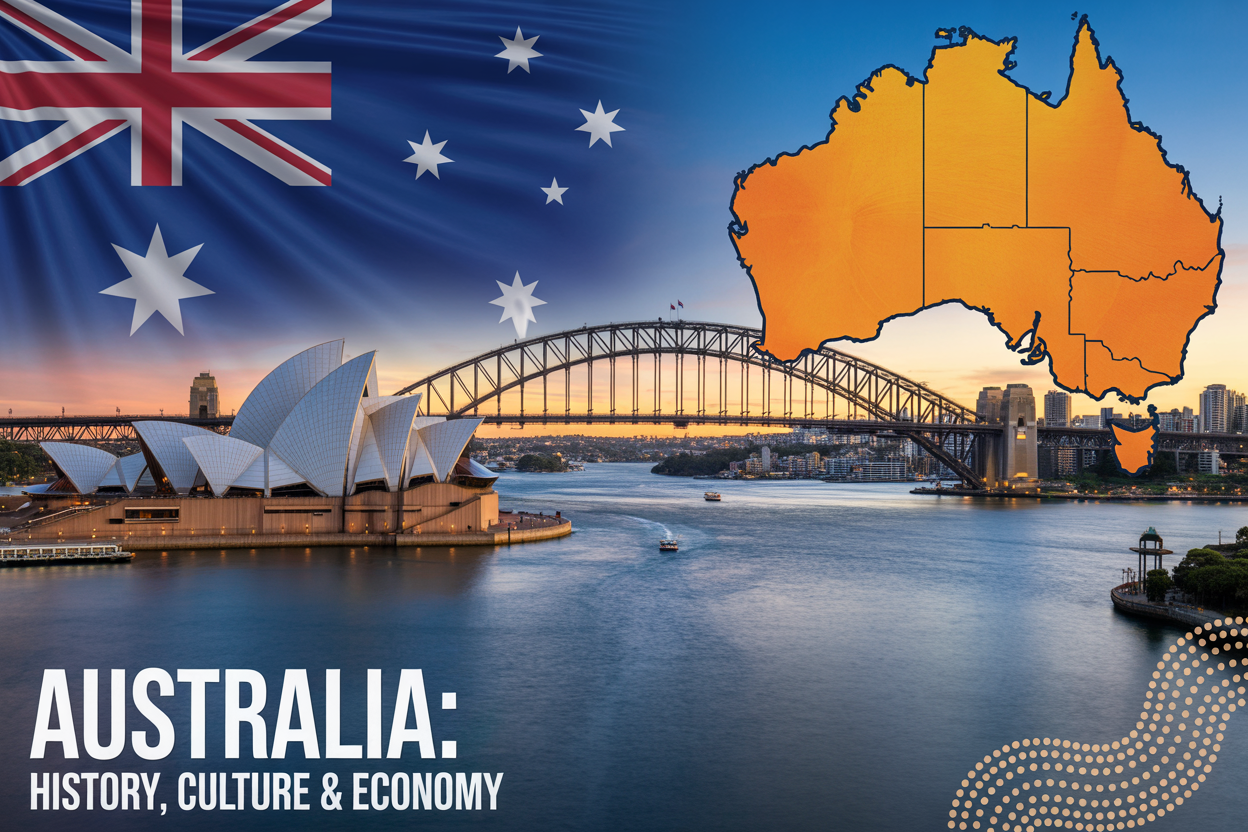
Australia stands as one of the world’s most fascinating nations, blending ancient Aboriginal heritage with modern multicultural society. This comprehensive guide serves students, travelers, and anyone curious about the Land Down Under who wants to understand what makes Australia unique.
You’ll discover Australia’s rich history spanning 65,000 years of Indigenous culture through British colonization to today’s independent democracy. We’ll explore the vibrant cultural identity that emerged from this diverse background and how it shapes modern Australian life. Finally, you’ll learn about Australia’s economic transformation from a resource-dependent colony to a major Asia-Pacific trading powerhouse.
From the red deserts of the Outback to bustling coastal cities, Australia’s story reveals how geography, people, and opportunity created one of the world’s most successful nations.
Historical Timeline and Colonial Heritage
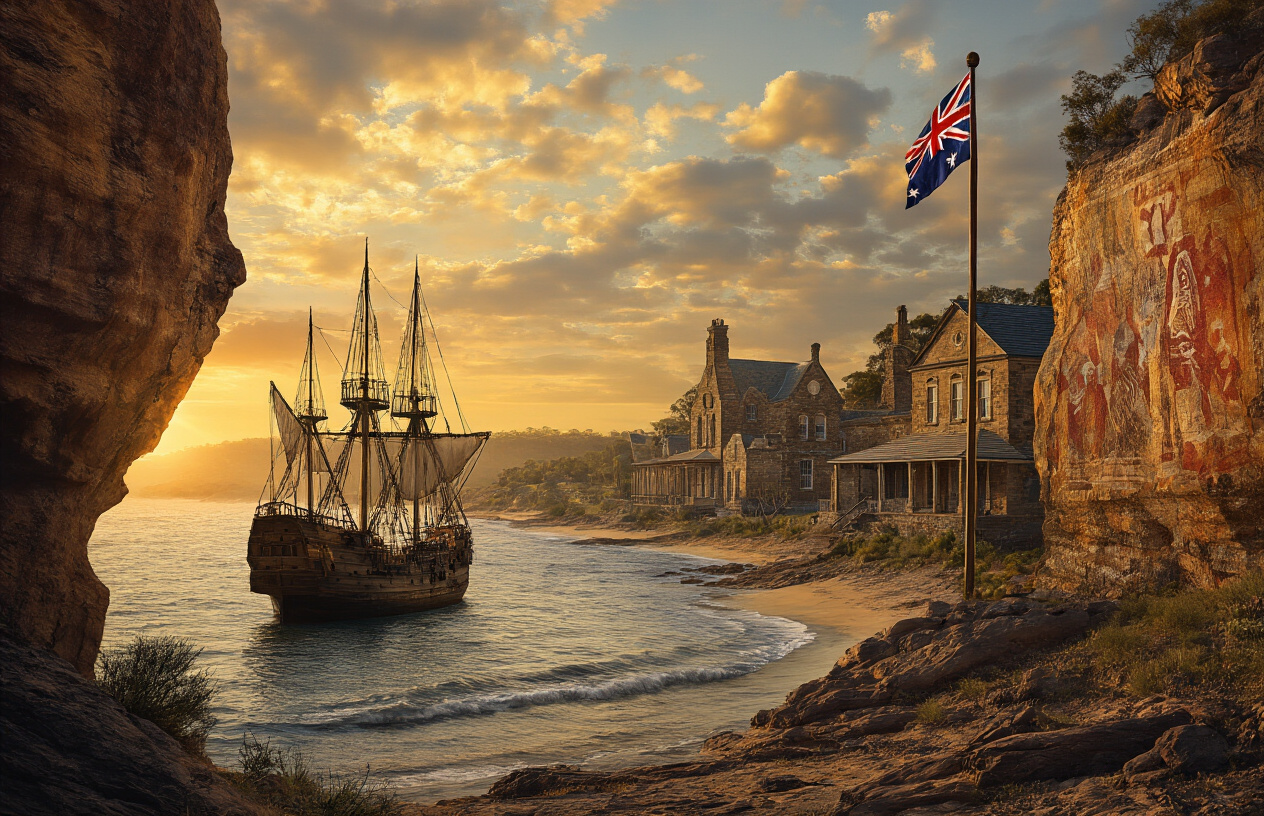
Indigenous Aboriginal Culture Spanning 65,000 Years
Aboriginal and Torres Strait Islander peoples represent the world’s oldest continuous cultures, with archaeological evidence placing their presence in Australia at least 65,000 years ago. These diverse communities developed sophisticated societies across the continent, creating intricate kinship systems, complex spiritual beliefs centered around the Dreamtime, and sustainable land management practices that shaped the Australian landscape for millennia.
Aboriginal peoples developed over 250 distinct languages and maintained rich oral traditions that preserved knowledge about astronomy, medicine, navigation, and environmental management. Their deep connection to Country—a concept encompassing land, water, air, trees, rocks, plants, animals, and spiritual beliefs—formed the foundation of their cultural identity. Rock art sites across Australia, some dating back over 40,000 years, showcase the world’s longest continuous artistic tradition.
Traditional Aboriginal societies operated through complex trading networks that spanned thousands of kilometers, exchanging goods like ochre, shells, tools, and ceremonial objects. Their sophisticated understanding of seasonal patterns and ecological relationships allowed them to thrive in diverse environments from tropical rainforests to arid deserts.
European Discovery and Settlement in the 18th Century
Captain James Cook’s arrival on Australia’s eastern coast in 1770 marked the beginning of European contact, though Dutch navigators had previously mapped parts of the continent’s western and northern shores. Cook claimed the eastern coastline for Britain under the legal fiction of terra nullius, ignoring the existing Aboriginal presence and their established rights to the land.
The First Fleet arrived at Sydney Cove on January 26, 1788, carrying approximately 1,400 people including 778 convicts, establishing the first permanent European settlement. Governor Arthur Phillip faced immediate challenges including food shortages, hostile relations with local Aboriginal groups, and the difficulties of establishing agriculture in unfamiliar conditions.
Early colonial expansion along the eastern seaboard brought devastating consequences for Aboriginal communities through disease, dispossession, and violent conflicts. European diseases like smallpox decimated Aboriginal populations who had no immunity to these introduced pathogens. The colonial government’s failure to recognize Aboriginal land rights led to ongoing frontier wars and the systematic displacement of Indigenous communities from their traditional territories.
Gold Rush Era and Population Boom
The discovery of gold in New South Wales in 1851, followed by major finds in Victoria, transformed Australia from a penal colony into a destination for free immigrants seeking fortune. The Victorian goldfields at Ballarat and Bendigo attracted prospectors from around the world, including significant numbers of Chinese miners, creating Australia’s first major wave of non-European immigration.
Gold rush towns sprang up almost overnight, complete with banks, hotels, theaters, and newspapers. Melbourne’s population exploded from 23,000 in 1851 to over 125,000 by 1854, making it one of the world’s fastest-growing cities. The influx of wealth funded major infrastructure projects including railways, telegraph lines, and public buildings that established the foundations of modern Australian cities.
The period also witnessed significant social tensions, exemplified by the Eureka Stockade rebellion in 1854 when miners protested against expensive mining licenses and lack of political representation. This event became a symbol of Australian democratic ideals and workers’ rights, influencing the development of the nation’s egalitarian political culture.
Federation Formation in 1901
The six separate British colonies recognized the need for political union to address common challenges including defense, trade barriers between colonies, and immigration policies. Federation debates throughout the 1890s centered on creating a unified nation while preserving individual colony interests and identities.
The Australian Constitution, drafted through a series of conventions and approved by colonial referendums, established a federal system balancing state and national powers. Key compromises included locating the national capital in New South Wales (but not Sydney) and guaranteeing equal state representation in the Senate regardless of population size.
On January 1, 1901, the Commonwealth of Australia officially formed with Edmund Barton as its first Prime Minister. The new nation immediately implemented the White Australia Policy, restricting non-European immigration and reflecting the racial attitudes of the era. This policy would remain in various forms until the 1970s, significantly shaping Australia’s demographic development during its first seven decades as a unified nation.
Cultural Identity and Modern Society
Multicultural Population Creating Unique Blend
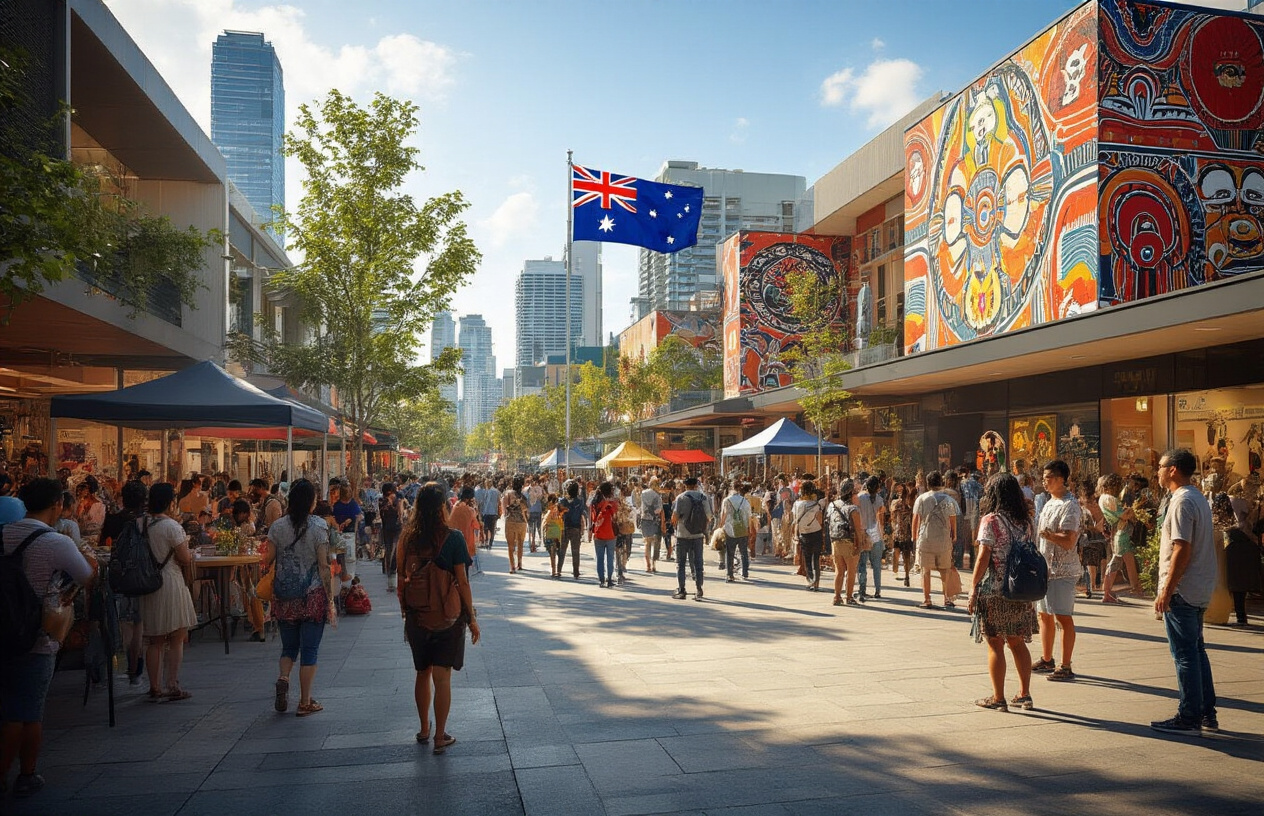
Australia stands as one of the world’s most culturally diverse nations, with nearly half of its population either born overseas or having at least one parent born in another country. This remarkable diversity creates a social fabric where over 300 languages are spoken in homes across the continent, making it a living testament to successful multiculturalism.
The country’s major cities showcase this diversity beautifully. Sydney’s Chinatown buzzes with authentic dim sum restaurants alongside Vietnamese pho joints, while Melbourne’s laneways feature Greek cafes next to Ethiopian eateries. These neighborhoods aren’t tourist attractions – they’re thriving communities where cultures blend naturally.
What makes Australia’s multiculturalism work is how different communities maintain their traditions while embracing Australian values. Diwali celebrations light up city squares, Greek Orthodox Easter brings families together in parks, and Chinese New Year parades draw crowds from all backgrounds. Food markets become melting pots where Italian nonnas share recipes with Lebanese grandmothers, and where you can find the best baklava made by a chef whose family came from Vietnam.
This cultural mixing creates uniquely Australian experiences. You might attend a wedding where traditional Aboriginal ceremonies blend with Indian rituals, or enjoy a backyard barbecue featuring Lebanese tabbouleh alongside classic meat pies. Schools celebrate Harmony Day, where children wear orange and share stories from their family’s heritage, creating understanding from an early age.
Indigenous Art and Dreamtime Stories
Aboriginal art represents the world’s oldest continuous art tradition, stretching back over 65,000 years. These aren’t museum pieces gathering dust – they’re living expressions of culture that continue evolving while maintaining deep spiritual connections to country and ancestry.
Rock art sites across Australia tell stories that predate European civilization by tens of thousands of years. Kakadu National Park alone contains over 5,000 art sites, with paintings that document everything from extinct megafauna to the arrival of European ships. These galleries carved into stone serve as history books, teaching tools, and sacred spaces all at once.
Contemporary Aboriginal artists like Emily Kame Kngwarreye and Clifford Possum Tjapaltjarri have gained international recognition, with their works selling for millions at auction. Their dot paintings might look abstract to outsiders, but each work contains layers of meaning – maps of ancestral journeys, seasonal calendars, or sacred ceremonies passed down through generations.
The Dreamtime stories that inspire much Aboriginal art explain how the land was formed and how people should live within it. These aren’t just creation myths – they’re practical guides for sustainable living, teaching which plants are edible, how to read weather patterns, and where to find water during dry seasons.
Urban Aboriginal artists are also making their mark, using street art, digital media, and contemporary galleries to share their perspectives on modern Australia. Their work often addresses social justice issues while celebrating cultural resilience, creating bridges between traditional and contemporary expression.
Sports Culture and Outdoor Lifestyle
Sports aren’t just entertainment in Australia – they’re part of the national DNA. Weekend mornings see suburban ovals filled with kids playing Australian Rules Football, netball courts bustling with competition, and swimming pools hosting local meets. This isn’t forced participation; it’s cultural expectation that being active and playing sport builds character.
The country practically shuts down during major sporting events. The Melbourne Cup stops the nation for a horse race, while State of Origin rugby league games divide friends and families along Queensland-New South Wales lines. Cricket matches become summer rituals where families spend entire days at the ground, more interested in the social experience than the actual score.
Beach culture defines coastal living for most Australians. Surf lifesaving clubs aren’t just about water safety – they’re community centers where generations of families volunteer together. Nippers programs teach children ocean skills alongside life values, creating confident swimmers and responsible citizens. The iconic red and yellow caps of surf lifesavers represent more than rescue services; they symbolize community spirit and looking out for others.
The outdoors beckons Australians beyond organized sports. Bushwalking trails crisscross the continent, from easy coastal paths to challenging mountain routes. National parks become weekend destinations for families seeking adventure and connection with nature. Camping isn’t roughing it – it’s quality time away from screens and city noise.
This outdoor lifestyle shapes Australian attitudes toward health, community, and environmental stewardship. People who spend weekends in nature tend to care more about protecting it, while sports participation creates social bonds that cross cultural and economic boundaries.
Geographic Layout and Capital Cities
Six States and Two Territories Overview
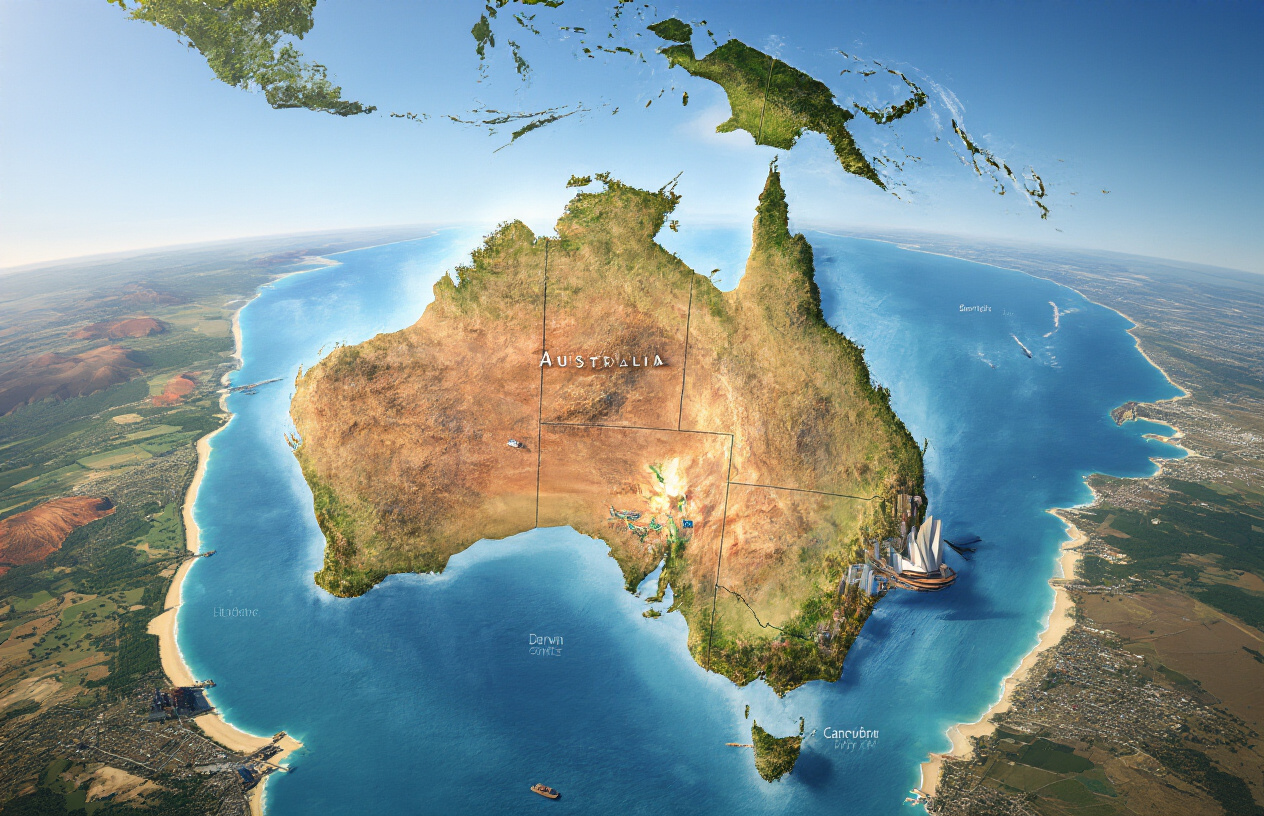
Australia’s political landscape divides into six states and two territories, each with distinct characteristics and governance structures. New South Wales, Victoria, Queensland, Western Australia, South Australia, and Tasmania make up the states, while the Australian Capital Territory and Northern Territory complete the federal arrangement.
The states retain significant autonomy over education, healthcare, transport, and law enforcement, while the federal government manages defense, immigration, and foreign affairs. Western Australia dominates geographically, covering nearly one-third of the continent, while Tasmania remains the smallest state as an island off the southern coast.
Queensland stretches along the eastern coastline, housing the Great Barrier Reef and tropical regions. Victoria concentrates much of its population in the southeast corner around Melbourne, while South Australia centers around Adelaide and encompasses vast desert regions. New South Wales holds the largest population and includes both Sydney and significant rural areas.
| State/Territory | Capital | Area (km²) | Population |
|---|---|---|---|
| Western Australia | Perth | 2,645,615 | 2.8 million |
| Queensland | Brisbane | 1,851,736 | 5.2 million |
| Northern Territory | Darwin | 1,420,970 | 250,000 |
| South Australia | Adelaide | 1,044,353 | 1.8 million |
| New South Wales | Sydney | 809,952 | 8.2 million |
| Victoria | Melbourne | 237,657 | 6.7 million |
| Tasmania | Hobart | 90,758 | 540,000 |
| ACT | Canberra | 2,358 | 430,000 |
Canberra as Federal Capital and Government Center
Canberra emerged as Australia’s purpose-built capital in 1913, resolving the rivalry between Sydney and Melbourne for national supremacy. American architect Walter Burley Griffin designed this planned city, integrating natural landscapes with urban development around Lake Burley Griffin.
The Australian Capital Territory houses all three branches of federal government. Parliament House, completed in 1988, sits atop Capital Hill and serves as the nation’s political epicenter. The High Court of Australia, Australian War Memorial, and numerous national institutions call Canberra home.
Unlike other Australian capitals that developed organically around ports or rivers, Canberra’s geometric layout reflects careful planning. The city’s design incorporates extensive parklands, artificial lakes, and mountain views, creating a unique urban environment that balances governmental functions with livability.
Canberra’s population has grown steadily since federation, reaching over 430,000 residents. The city maintains one of Australia’s highest education levels, with the Australian National University and several research institutions driving innovation and academic excellence.
Major Cities and Regional Centers
Australia’s urban population concentrates heavily in coastal cities, with over 80% of residents living within 100 kilometers of the ocean. Sydney and Melbourne dominate as global cities, each exceeding 5 million inhabitants and serving as economic and cultural powerhouses.
Sydney operates as the financial capital, hosting the Australian Securities Exchange and major corporate headquarters. Its harbor location and iconic landmarks like the Opera House cement its status as Australia’s most recognizable city internationally.
Melbourne claims the cultural capital title, renowned for coffee culture, street art, and sports events. The city’s laneways, diverse neighborhoods, and food scene attract millions of visitors annually. Melbourne also leads in fashion, design, and creative industries.
Brisbane anchors Queensland’s growth corridor, benefiting from subtropical climate and proximity to tourist destinations. Perth’s isolation on the western coast hasn’t hindered its development as a resources industry hub, while Adelaide maintains a reputation for wine, arts, and measured urban growth.
Regional centers like Newcastle, Wollongong, Gold Coast, Cairns, Townsville, Darwin, Alice Springs, and Hobart serve as important economic nodes, connecting remote areas with major metropolitan centers and providing services to surrounding agricultural and mining communities.
Unique Landscapes from Outback to Coastlines
Australia’s continental diversity spans from tropical rainforests to arid deserts, creating some of the world’s most varied landscapes within a single country. The Outback covers roughly 70% of the landmass, characterized by red soil, sparse vegetation, and extreme weather conditions.
The eastern coastline features the Great Dividing Range, Australia’s longest mountain chain, which captures moisture from Pacific Ocean weather systems and creates fertile river valleys. These mountains gradually transition from temperate forests in the south to tropical environments in far north Queensland.
Western Australia’s coastline stretches over 20,000 kilometers, encompassing everything from pristine beaches to rugged cliff formations. The Pilbara region contains some of Earth’s oldest rocks and largest iron ore deposits, while the Kimberley region showcases dramatic gorges and ancient indigenous art sites.
Central Australia presents the iconic red center, home to Uluru and vast desert plains that experience extreme temperature variations. The Great Western Woodlands in southwestern Australia contains globally significant eucalyptus forests, while the island state of Tasmania preserves temperate rainforests and alpine regions found nowhere else on the continent.
Coastal regions support most urban development, taking advantage of moderate climates and natural harbors. The contrast between populated coastal strips and empty interior creates a demographic pattern unique among developed nations, with cities separated by hundreds of kilometers of largely uninhabited land.
National Symbols and Identity
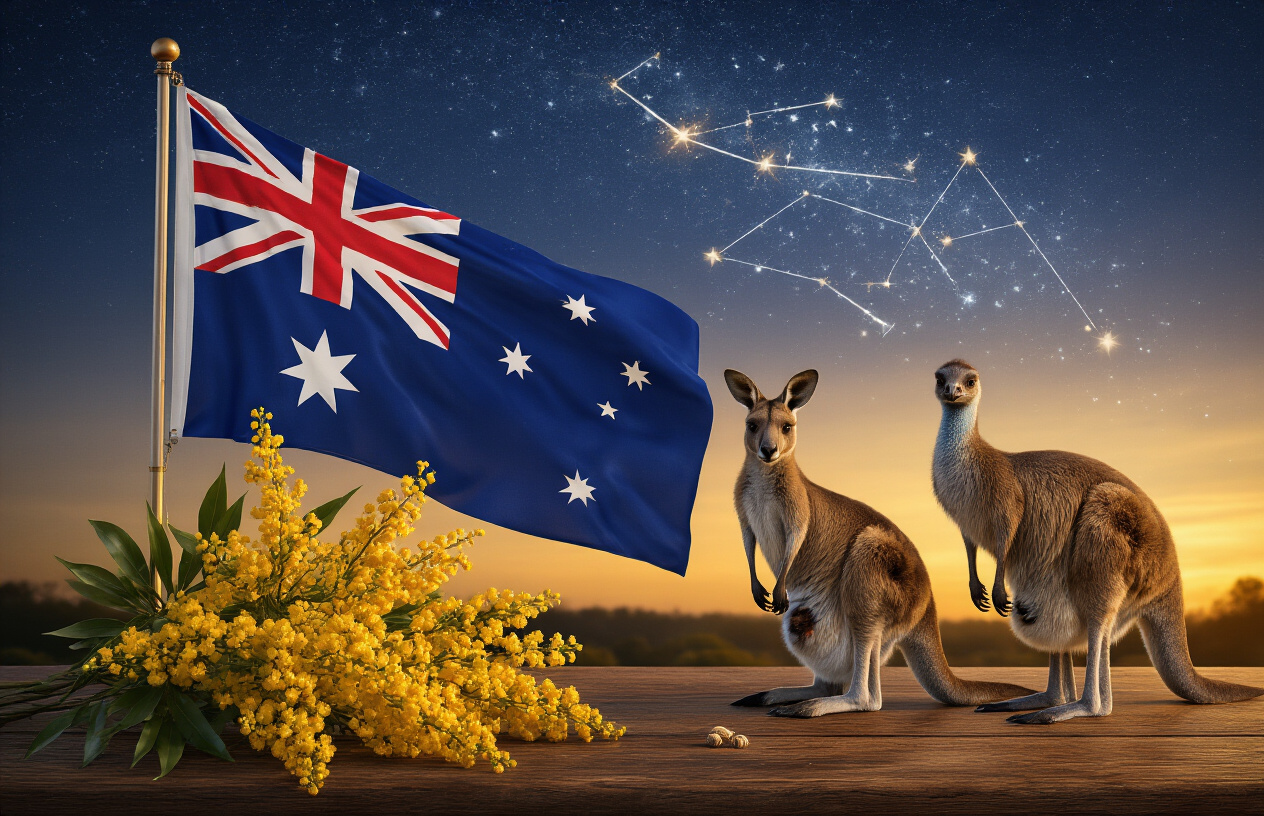
Flag Design Representing British Heritage and Southern Cross
The Australian flag tells a story of colonial roots and celestial navigation through its distinctive blue canvas. The Union Jack sits prominently in the upper left corner, acknowledging the nation’s British colonial past and continued membership in the Commonwealth. This symbol represents the historical foundation that shaped Australia’s legal system, language, and governmental structure.
The Southern Cross constellation dominates the right side of the flag, featuring four seven-pointed stars and one five-pointed star. This celestial arrangement has guided navigators across the Southern Hemisphere for centuries and holds special meaning for Australians as a uniquely southern sky marker. The larger Commonwealth Star beneath the Union Jack contains seven points representing the six states and territories, symbolizing the federation that united the continent under one government.
The deep blue background connects Australia to both its maritime heritage and the vast southern skies. While some Australians have called for flag redesign to better reflect modern multicultural identity, the current design remains deeply embedded in national consciousness and official ceremonies.
Coat of Arms Featuring Native Animals
Australia’s coat of arms showcases the continent’s most iconic native animals through the kangaroo and emu, both chosen for their inability to walk backward—symbolizing a nation moving forward. These animals support a shield divided into six sections representing each state, with their individual badges creating a unified national identity.
The golden wattle forms a decorative border around the base, serving as Australia’s national floral emblem. This bright yellow bloom represents resilience and unity, flowering even in harsh conditions across the continent. Above the shield sits a seven-pointed Commonwealth Star, echoing the flag’s symbolism of federal unity.
The motto “Advance Australia” appears on a banner below, capturing the optimistic spirit of progress and development. Royal symbols including a crown acknowledge constitutional monarchy status, while the overall design balances Indigenous wildlife with British heraldic traditions. Government departments, courts, and official documents display this emblem as the ultimate symbol of Australian sovereignty and authority.
National Anthem and Cultural Ceremonies
“Advance Australia Fair” became the official national anthem in 1984, replacing “God Save the Queen” to better reflect Australian identity. The lyrics celebrate the continent’s natural beauty, multicultural society, and democratic values while acknowledging both Indigenous heritage and immigrant contributions. School assemblies, sporting events, and citizenship ceremonies regularly feature this anthem, creating shared moments of national connection.
Australia Day ceremonies on January 26th blend flag-raising, anthem singing, and citizenship presentations for new Australians. ANZAC Day holds even deeper significance, honoring military service members through dawn services, parades, and two-up games. These ceremonies combine solemn remembrance with community celebration, reflecting Australian values of mateship and sacrifice.
Indigenous cultural ceremonies increasingly feature in national events, acknowledging the First Nations peoples who inhabited the continent for over 60,000 years. Welcome to Country ceremonies and the flying of Aboriginal and Torres Strait Islander flags alongside the national flag demonstrate growing recognition of Indigenous sovereignty and cultural continuity.
Government House receptions, parliamentary openings, and royal visits follow established protocols combining British ceremonial traditions with distinctly Australian elements, creating unique expressions of national identity that honor the past while embracing contemporary multiculturalism.
Demographics and Population Distribution
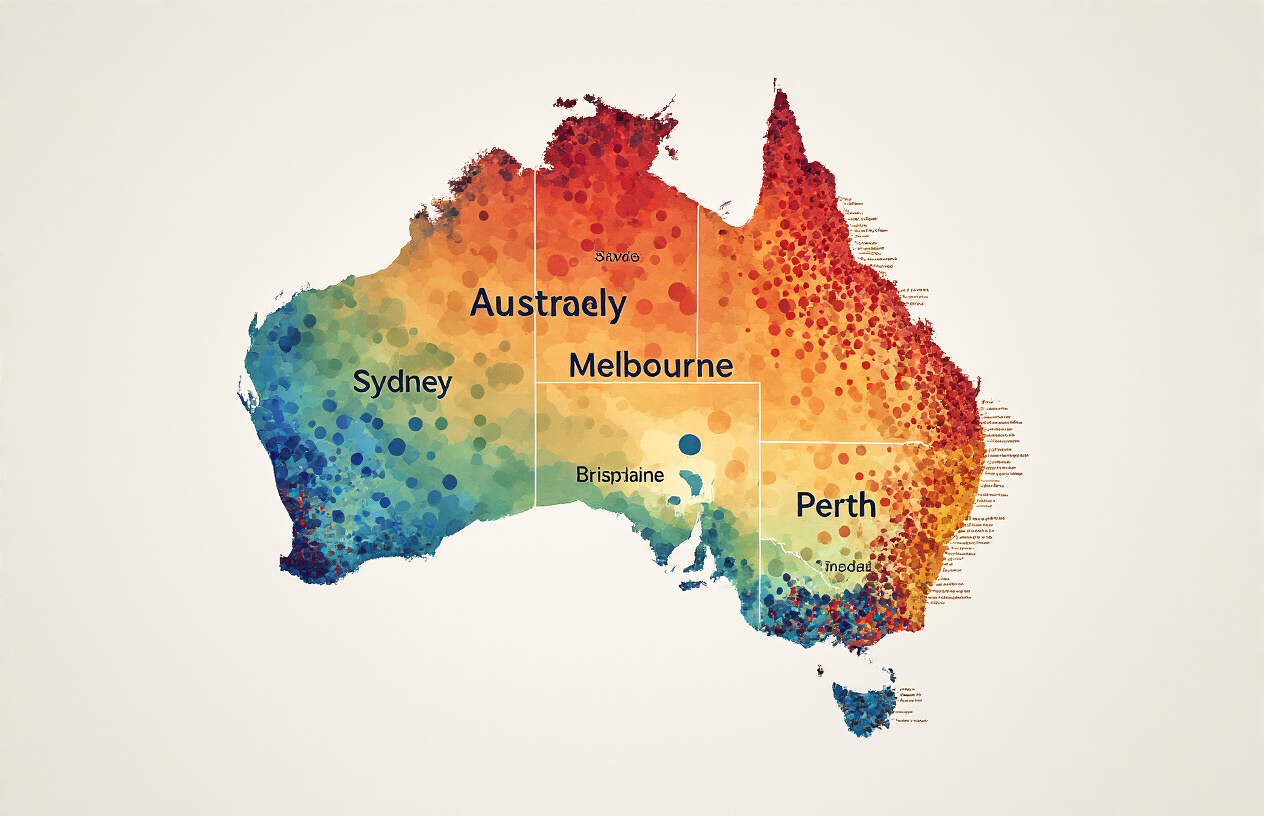
Current Population Statistics and Growth Trends
Australia’s population reached approximately 26.6 million people as of 2024, making it one of the most sparsely populated countries globally with just 3.5 people per square kilometer. The nation has experienced steady population growth averaging 1.3% annually over the past decade, driven primarily by immigration rather than natural increase.
The growth trajectory shows fascinating patterns. While the birth rate hovers around 1.66 children per woman—below replacement level—net overseas migration contributes roughly 60% of population growth. Major cities like Sydney and Melbourne add around 100,000 new residents each year, creating both opportunities and infrastructure challenges.
Population projections suggest Australia will reach 30 million by 2030, with growth rates expected to moderate slightly due to global demographic shifts and changing immigration policies. Regional variations are stark: while major metropolitan areas boom, rural populations often decline as young people migrate to cities for education and employment opportunities.
Urban Concentration in Coastal Cities
Australia ranks among the world’s most urbanized nations, with 86% of the population living in urban areas. The coastal concentration is particularly striking—nearly 85% of Australians live within 50 kilometers of the coastline, creating a unique settlement pattern that leaves vast interior regions virtually uninhabited.
The five largest metropolitan areas house over 60% of the total population:
| City | Population (2024) | Share of National Population |
|---|---|---|
| Sydney | 5.4 million | 20.3% |
| Melbourne | 5.2 million | 19.5% |
| Brisbane | 2.7 million | 10.1% |
| Perth | 2.2 million | 8.3% |
| Adelaide | 1.4 million | 5.3% |
This concentration creates what demographers call the “big Australia” phenomenon—rapid urban expansion that strains housing markets, transportation networks, and public services. Sydney and Melbourne account for nearly 40% of the nation’s population combined, wielding enormous economic and political influence.
Coastal preference stems from historical settlement patterns, economic opportunities, and lifestyle factors. Most Australians live within an hour’s drive of beaches, enjoying temperate climates and avoiding the harsh interior conditions. This pattern continues intensifying as climate change makes inland areas increasingly challenging for large-scale settlement.
Immigration Patterns and Ethnic Diversity
Modern Australia represents one of the world’s most successful multicultural societies, with overseas-born residents comprising 30% of the population. Immigration waves have transformed the nation from predominantly Anglo-Celtic origins to remarkable ethnic diversity.
Recent immigration trends show significant shifts in source countries:
Top Immigration Sources (2019-2024):
- India: 163,000 permanent arrivals
- China: 87,000 permanent arrivals
- Philippines: 45,000 permanent arrivals
- Nepal: 32,000 permanent arrivals
- Vietnam: 28,000 permanent arrivals
The skilled migration program attracts highly educated professionals, while family reunion visas maintain community connections. Humanitarian intake, though smaller in numbers, adds cultural richness and addresses global refugee challenges.
Language diversity reflects this multicultural reality. While English remains the primary language, over 300 languages are spoken in Australian homes. Mandarin, Arabic, Vietnamese, Cantonese, and Hindi rank as the most common non-English languages, particularly in major cities.
Second and third-generation Australians often maintain cultural connections while fully integrating into Australian society. This creates dynamic communities where traditional festivals, cuisines, and customs blend with Australian lifestyle preferences, producing unique cultural expressions found nowhere else globally.
Age Structure and Life Expectancy Rates
Australia’s population pyramid shows characteristics of a developed nation with below-replacement fertility rates and increasing longevity. The median age has risen to 38.5 years, reflecting broader demographic transitions affecting developed economies worldwide.
Current Age Distribution:
- 0-14 years: 19.3% of population
- 15-64 years: 65.2% of population
- 65+ years: 15.5% of population
Life expectancy ranks among the world’s highest at 83.2 years overall—85.4 years for women and 81.2 years for men. This longevity creates both opportunities and challenges. Healthy, active seniors contribute significantly to volunteer work, grandparent care, and economic activity well beyond traditional retirement ages.
The aging population creates pressure on healthcare systems, aged care services, and pension schemes. By 2040, experts predict 22% of Australians will be over 65, fundamentally altering workforce dynamics and social support needs.
Regional variations in age structure are pronounced. Inner-city areas attract young professionals, while coastal retirement destinations like the Gold Coast and Sunshine Coast show much older age profiles. Rural areas often lose young adults to urban centers, creating communities with aging populations and declining services.
Birth rates vary significantly by background, with some immigrant communities maintaining higher fertility rates than the national average, adding complexity to demographic planning and cultural policy development.
Economic Powerhouse and Trade Relations
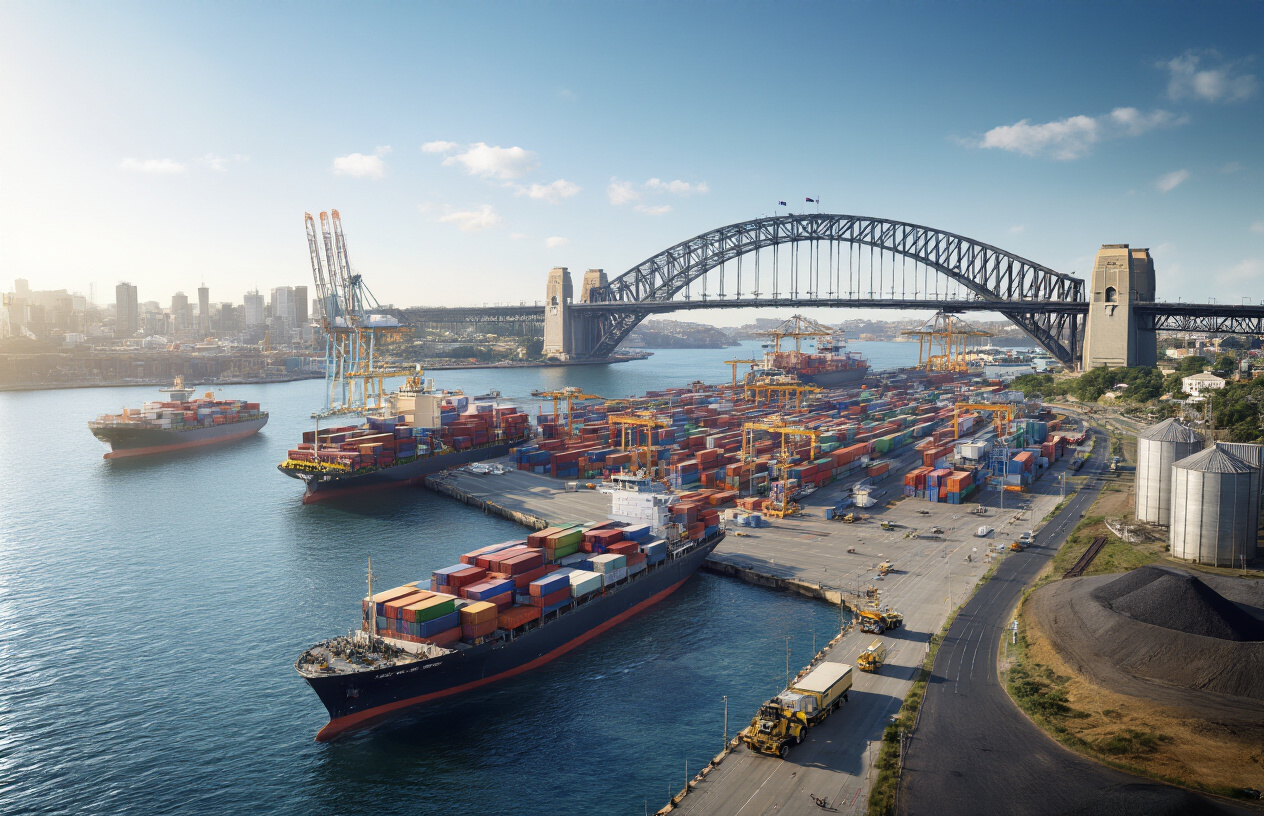
Natural Resources and Mining Industry Dominance
Australia sits on one of the world’s richest mineral deposits, making it a global mining superpower. The country leads global production in several key commodities, including iron ore, coal, gold, and lithium. Western Australia’s Pilbara region alone produces over half of the world’s iron ore, with massive operations shipping billions of tons annually to steel-hungry economies across Asia.
Coal mining generates substantial revenue through both thermal coal for energy production and coking coal for steel manufacturing. Queensland’s Bowen Basin and New South Wales’s Hunter Valley represent two of the world’s largest coal-producing regions. The recent lithium boom has positioned Australia as the world’s largest lithium producer, capitalizing on the global shift toward electric vehicles and renewable energy storage.
| Resource | Global Ranking | Key Regions |
|---|---|---|
| Iron Ore | #1 | Western Australia |
| Coal | #2 | Queensland, NSW |
| Gold | #2 | Western Australia |
| Lithium | #1 | Western Australia |
| Natural Gas | Top 5 | Western Australia, Queensland |
Mining contributes approximately 10% of Australia’s GDP and employs over 250,000 people directly. The sector’s influence extends far beyond extraction, driving infrastructure development, technological innovation, and regional economic growth across remote areas.
Agricultural Exports and Farming Sectors
Australian agriculture punches well above its weight on the global stage, feeding roughly 75 million people worldwide despite the continent’s challenging climate conditions. The country ranks among the world’s top wheat exporters, with Western Australia’s wheatbelt producing high-quality grain that commands premium prices in Asian markets.
Beef production represents another agricultural cornerstone, with Australia maintaining the world’s largest cattle herd and consistently ranking as the third-largest beef exporter globally. The industry spans from intensive feedlots in Queensland to extensive grazing operations across the Northern Territory and Western Australia.
Dairy farming, concentrated primarily in Victoria and Tasmania, produces world-class milk, cheese, and butter products. Australian dairy exports reach over 100 countries, with powdered milk and infant formula particularly sought after in Asian markets due to strict quality standards and clean production environments.
The wine industry has transformed from local consumption to global recognition, with regions like Barossa Valley, Hunter Valley, and Margaret River producing internationally acclaimed vintages. Australian wine exports generate billions annually, with China, the United Kingdom, and the United States representing key markets.
Unique agricultural products include macadamia nuts, where Australia dominates global production, and merino wool, renowned for its exceptional quality and softness.
Service Economy and Tourism Revenue
The service sector drives modern Australia’s economy, accounting for roughly 70% of GDP and employing the majority of the workforce. Financial services, centered in Sydney and Melbourne, have evolved into regional powerhouses serving the Asia-Pacific market. Major Australian banks like Commonwealth Bank and Westpac rank among the world’s most profitable and stable financial institutions.
Education exports have become a massive revenue generator, with Australia ranking as the world’s third-largest destination for international students. Universities in Sydney, Melbourne, and Brisbane attract hundreds of thousands of students annually, contributing over $40 billion to the economy while building lasting cultural and business connections with Asia.
Tourism traditionally contributed significant economic value before facing challenges during recent global disruptions. The Great Barrier Reef, Uluru, Sydney Opera House, and Melbourne’s cultural scene attract millions of visitors yearly. Domestic tourism also plays a crucial role, with Australians exploring their own continent’s diverse landscapes from tropical Queensland to rugged Tasmania.
Professional services including legal, consulting, and technology sectors have expanded rapidly, with Australian firms increasingly serving international clients. The country’s time zone advantage allows seamless business connections with both Asian and European markets.
International Trade Partnerships and Economic Growth
China represents Australia’s largest trading partner, accounting for roughly 30% of total trade value. This relationship centers on resource exports – iron ore and coal flowing to China while manufactured goods, electronics, and consumer products return to Australia. Despite occasional diplomatic tensions, economic interdependence remains strong.
Japan maintains a long-standing trade partnership, particularly in energy resources. Australia supplies significant quantities of liquefied natural gas (LNG) and coal to meet Japan’s energy needs, while importing automobiles, machinery, and technology products.
The United States partnership extends beyond traditional trade into technology, defense, and services. American investment in Australian mining, technology, and renewable energy sectors continues growing, while Australian firms expand into American markets.
Regional trade agreements like the Comprehensive and Progressive Trans-Pacific Partnership (CPTPP) and the Regional Comprehensive Economic Partnership (RCEP) provide preferential access to growing Asian markets. These agreements reduce tariffs on agricultural products and create opportunities for service sector expansion.
South Korea, India, and Southeast Asian nations represent emerging trade opportunities. India’s growing economy creates demand for Australian resources and education services, while ASEAN countries offer manufacturing partnerships and tourism exchange.
Australia’s economic growth strategy increasingly focuses on value-added exports rather than raw materials alone. Processing facilities for minerals, advanced manufacturing, and technology development aim to capture more value from natural resource advantages while building resilience against commodity price fluctuations.
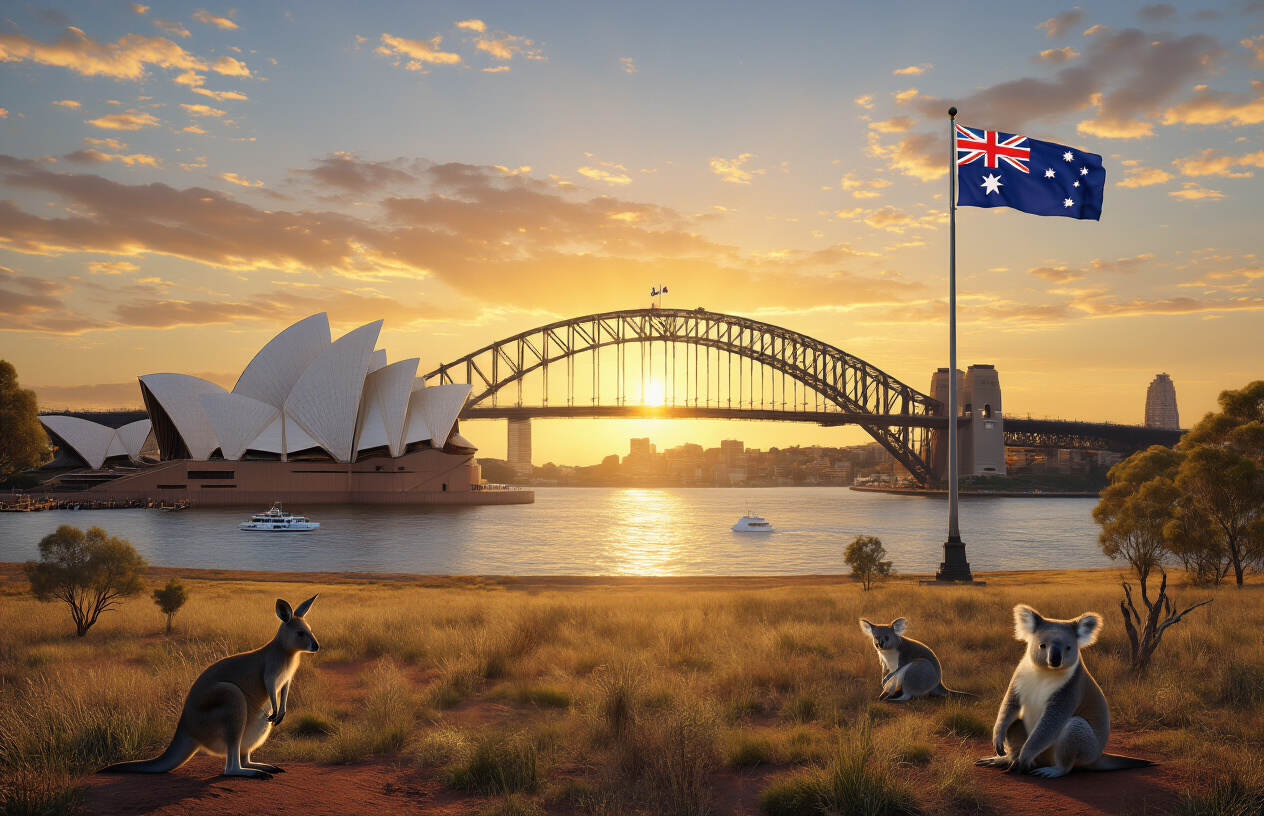
Australia’s journey from British colony to modern economic powerhouse shows just how much a nation can transform over two centuries. The country’s blend of Indigenous heritage, colonial history, and multicultural immigration has created a unique society that balances respect for ancient traditions with cutting-edge innovation. From the bustling streets of Sydney and Melbourne to the vast outback territories, Australia’s geographic diversity matches its cultural richness, with Canberra serving as the carefully planned political heart of the nation.
Looking at Australia today, it’s clear that the country has successfully positioned itself as a major player on the world stage. With a population of over 25 million people contributing to one of the world’s most stable economies, Australia continues to attract immigrants, investors, and tourists alike. The Southern Cross on the national flag represents more than just geographic location – it symbolizes a nation that has found its place among the stars while keeping its feet firmly planted in the rich red earth that defines so much of its identity.

Nasir Uddin is a dedicated writer and researcher at BanglaLook.com, where he explores topics related to education, Bangladeshi culture, lifestyle, and travel. With a strong passion for learning and storytelling, he blends personal observation with well-researched insights to help readers better understand Bangladesh and the world around them.